Peloton could monetize these ideas if they only listen
Peloton does not need to look far for profitable ideas
I bought my Peloton at the Black Friday sale in 2017. It has transformed my health and well-being. However, loyalty should only be reserved for family, nation, and religion — Peloton is neither. Peloton is a company that needs to listen to its customers to grow.
As of December 2019, Peloton had 712 thousand subscribers. As of June 2021, Peloton had 2.33 million subscribers. (Source).
As of Q2 2022, Peloton has 2.93 million connected fitness subscriptions. (Source).
The above data means that less than a quarter of subscribers bought Peloton pre-COVID19. Given a 12-month retention rate of 92%, it's likely even less. I happen to be among this group.
Here is something to think about: a full 75% of current Peloton subscribers have never seen a full studio on their tablets. They've never even been to the Peloton studio at all.
Peloton owes its early success in large part to the OGs.
For all the talk about community, Peloton hasn't done anything of substance to build it. They benefited from the social media groups that the OGs had made. The community that built itself around Peloton happened organically, sometimes in spite of Peloton.
Instead of listening to their most loyal customers, Peloton abandoned us. COVID-19 induced a boom in sales meant that they could focus on new users and leave the OGs. Classes became shorter, and new features became infrequent.
However, what's keeping me with Peloton is the quality of their content, but they could do better. Perhaps now that some 90% of shareholder value has been decimated and Peloton is sitting on a pile of unsold inventory, Peloton will finally listen.
Here is the thing, Peloton does not need to look far to see what premium features users are willing to pay for. All they need to do is take a look at mPaceline app, and PowerZone Pack — third party apps that monetized the features they built on top of Peloton content.
Cycling workout graphs
Let's start with the low-hanging fruit.
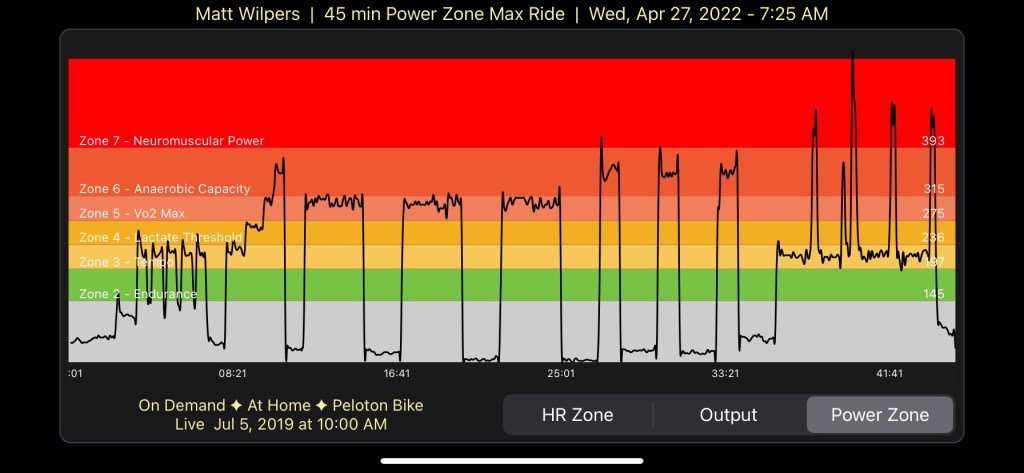
Can we get a power zone breakdown in the workout graphs? This one should not cost extra.
Search on-demand cycling workouts by power zone
Peloton has the data, and let us search it. To build effective power zone training plans, we need to be able to find the classes to take. An essential search feature to find classes by duration and maximum power zone would solve that.
Build and share custom training programs
PowerZonePack and mPaceline take a slightly different approach to custom training programs (plans).
mPaceline allows users to create training programs and share them with others. PowerZonePack takes a top-down approach where someone designs "challenges" and shares them with everyone else.
Peloton could both deliver a cool new feature , and monetize it.
Users should be able to create custom training programs using existing Peloton content. This is distinct from stacking, as stacking only allows up to 10 classes and is only meant for day-to-day workouts. I am describing an ability to create multi-week programs along the lines of "Build Your PowerZone."
A user that creates a training program can then share this program with others. They can do so for free. They can also sell it for a one-time fee, and Peloton can take a cut. Peloton could build a "Training Plan Store" of sorts and help advanced users monetize their creativity while also earning extra revenue.
Improve automated recommendations
Training programs are great, but they are only a few weeks long. What should we do in between programs?
Allow users to select a generic training plan out of a dozen or so options, for example, "Ride a Century", or "Maintain your FTP." Then, suggest daily classes using the most recently recorded on-demand content.
Consider the bigger picture
Peloton app will never be the primary fitness tracking app. Peloton is not FitBit, and they are not Apple Health. They do not have a wearable like Apple Watch or Oura Ring.
The new feature they added for recording off-Peloton outdoor workouts only solves the problem of some users wanting Peloton badges. However, Peloton could look at the data in Apple Health and make workout suggestions based on what they see:
"Looks like you did a 100 mile bike ride on Sunday. Today is Monday, and based on your resting heart rate and HRV, you could use a break today."
Some final thoughts
Peloton is not going to grow its hardware base. An argument can be made that everyone who ever wanted a connected spin bike or tread already bought one. I submit that they could grow app users.
If they stay in the hardware business, they need to find a way to get existing users to upgrade or pay for premium features.
PowerZonePack charges around $70/year on top of Peloton membership; mPaceline premium subscription is roughly $25/year. Both are great apps and have loyal communities built around them. Clearly, people are willing to pay for the features I am describing.
Why not monetize and build upon that?
Featured image: Peloton Bike via WikiMedia Commons.
