Archive

The Dulin Report

Browsable archive from the WordPress export.

Results (79)

On the role of Distinguished Engineer and CTO Mindset Apr 27, 2025 The future is bright Mar 30, 2025 On luck and gumption Oct 8, 2023 Some thoughts on recent RTO announcements Jun 22, 2023 One size does not fit all: neither cloud nor on-prem Apr 10, 2023 Comparing AWS SQS, SNS, and Kinesis: A Technical Breakdown for Enterprise Developers Feb 11, 2023 Working from home works as well as any distributed team Nov 25, 2022 Things to be Thankful for Nov 24, 2022 Why you should question the “database per service” pattern Oct 5, 2022 Stop Shakespearizing Sep 16, 2022 Using GNU Make with JavaScript and Node.js to build AWS Lambda functions Sep 4, 2022 Why don’t they tell you that in the instructions? Aug 31, 2022 Monolithic repository vs a monolith Aug 23, 2022 Keep your caching simple and inexpensive Jun 12, 2022 Java is no longer relevant May 29, 2022 There is no such thing as one grand unified full-stack programming language May 27, 2022 Peloton could monetize these ideas if they only listen May 15, 2022 Best practices for building a microservice architecture Apr 25, 2022 True identity verification should require a human Mar 16, 2020 The passwords are no longer a necessity. Let’s find a good alternative. Mar 2, 2020 What programming language to use for a brand new project? Feb 18, 2020 TDWI 2019: Architecting Modern Big Data API Ecosystems May 30, 2019 Configuring Peloton Apple Health integration Feb 16, 2019 All emails are free -- except they are not Feb 9, 2019 Using Markov Chain Generator to create Donald Trump's state of union speech Jan 20, 2019 The religion of JavaScript Nov 26, 2018 Teleportation can corrupt your data Sep 29, 2018 Let’s talk cloud neutrality Sep 17, 2018 A conservative version of Facebook? Aug 30, 2018 On Facebook and Twitter censorship Aug 20, 2018 Facebook is the new Microsoft Apr 14, 2018 Node.js is a perfect enterprise application platform Jul 30, 2017 Design patterns in TypeScript: Factory Jul 30, 2017 Design patterns in TypeScript: Chain of Responsibility Jul 22, 2017 Singletons in TypeScript Jul 16, 2017 Architecting API ecosystems: my interview with Anthony Brovchenko of R. Culturi Jun 5, 2017 TDWI 2017, Chicago, IL: Architecting Modern Big Data API Ecosystems May 30, 2017 I tried an Apple Watch for two days and I hated it Mar 30, 2017 Emails, politics, and common sense Jan 14, 2017 Online grocers have an additional burden to be reliable Jan 5, 2017 Here is to a great 2017! Dec 26, 2016 Apple’s recent announcements have been underwhelming Oct 29, 2016 I am addicted to Medium, and I am tempted to move my entire blog to it Sep 9, 2016 What I learned from using Amazon Alexa for a month Sep 7, 2016 Praising Bank of America's automated phone-based customer service Aug 23, 2016 Amazon Alexa is eating the retailers alive Jun 22, 2016 In search for the mythical neutrality among top-tier public cloud providers Jun 18, 2016 In Support Of Gary Johnson Jun 13, 2016 Files and folders: apps vs documents May 26, 2016 Why it makes perfect sense for Dropbox to leave AWS May 7, 2016 JEE in the cloud era: building application servers Apr 22, 2016 Managed IT is not the future of the cloud Apr 9, 2016 LinkedIn needs a reset Feb 13, 2016 In memory of Ed Yourdon Jan 23, 2016 OAuth 2.0: the protocol at the center of the universe Jan 1, 2016 IT departments must transform in the face of the cloud revolution Nov 9, 2015 Banking Technology is in Dire Need of Standartization and Openness Sep 28, 2015 Top Ten Differences Between ActiveMQ and Amazon SQS Sep 5, 2015 We Live in a Mobile Device Notification Hell Aug 22, 2015 On Maintaining Personal Brand as a Software Engineer Aug 2, 2015 Book Review: "Shop Class As Soulcraft" By Matthew B. Crawford Jul 5, 2015 Attracting STEM Graduates to Traditional Enterprise IT Jul 4, 2015 The longer the chain of responsibility the less likely there is anyone in the hierarchy who can actually accept it Jun 7, 2015 Guaranteeing Delivery of Messages with AWS SQS May 9, 2015 The Clarkson School Class of 2015 Commencement speech May 5, 2015 Apple is (or was) the Biggest User of Apache Cassandra Apr 23, 2015 Ordered Sets and Logs in Cassandra vs SQL Apr 8, 2015 Exploration of the Software Engineering as a Profession Apr 8, 2015 What can Evernote Teach Us About Enterprise App Architecture Apr 2, 2015 Microsoft and Apple Have Everything to Lose if Chromebooks Succeed Mar 31, 2015 Where AWS Elastic BeanStalk Could be Better Mar 3, 2015 Configuring Master-Slave Replication With PostgreSQL Jan 31, 2015 Docker can fundamentally change how you think of server deployments Aug 26, 2014 Infrastructure in the cloud vs on-premise Aug 25, 2014 Things I wish Apache Cassandra was better at Feb 12, 2014 "Hello, World!" Using Apache Thrift Feb 24, 2013 Thoughts on Wall Street Technology Aug 11, 2012 Scripting News: After X years programming Jun 5, 2012 Java, Linux and UNIX: How much things have progressed Dec 7, 2010

Peloton could monetize these ideas if they only listen

May 15, 2022

Peloton does not need to look far for profitable ideas


I bought my Peloton at the Black Friday sale in 2017. It has transformed my health and well-being. However, loyalty should only be reserved for family, nation, and religion — Peloton is neither. Peloton is a company that needs to listen to its customers to grow.


As of December 2019, Peloton had 712 thousand subscribers. As of June 2021, Peloton had 2.33 million subscribers. (Source).


As of Q2 2022, Peloton has 2.93 million connected fitness subscriptions. (Source).


The above data means that less than a quarter of subscribers bought Peloton pre-COVID19. Given a 12-month retention rate of 92%, it's likely even less. I happen to be among this group.


Here is something to think about: a full 75% of current Peloton subscribers have never seen a full studio on their tablets. They've never even been to the Peloton studio at all.


Peloton owes its early success in large part to the OGs.


For all the talk about community, Peloton hasn't done anything of substance to build it. They benefited from the social media groups that the OGs had made. The community that built itself around Peloton happened organically, sometimes in spite of Peloton.


Instead of listening to their most loyal customers, Peloton abandoned us. COVID-19 induced a boom in sales meant that they could focus on new users and leave the OGs. Classes became shorter, and new features became infrequent.


However, what's keeping me with Peloton is the quality of their content, but they could do better. Perhaps now that some 90% of shareholder value has been decimated and Peloton is sitting on a pile of unsold inventory, Peloton will finally listen.


Here is the thing, Peloton does not need to look far to see what premium features users are willing to pay for. All they need to do is take a look at mPaceline app, and PowerZone Pack — third party apps that monetized the features they built on top of Peloton content.


Cycling workout graphs


Let's start with the low-hanging fruit.
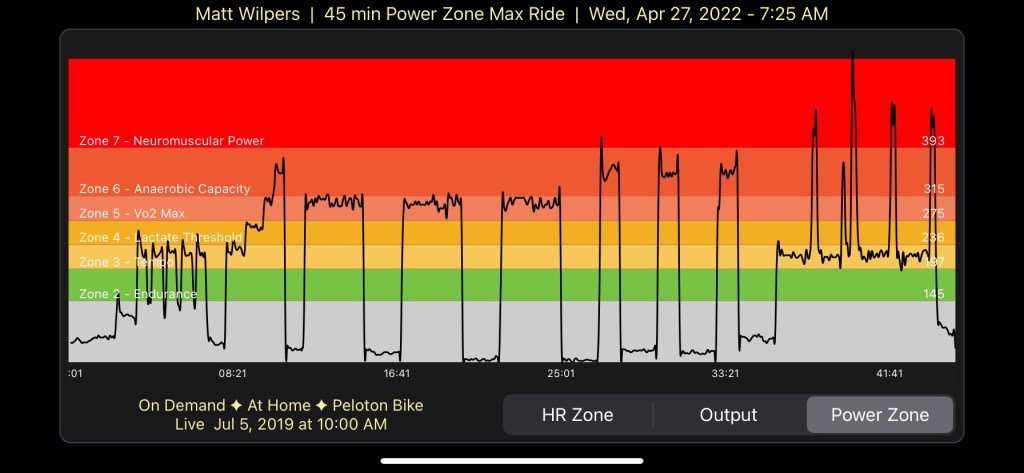


Can we get a power zone breakdown in the workout graphs? This one should not cost extra.


Search on-demand cycling workouts by power zone


Peloton has the data, and let us search it. To build effective power zone training plans, we need to be able to find the classes to take. An essential search feature to find classes by duration and maximum power zone would solve that.


Build and share custom training programs


PowerZonePack and mPaceline take a slightly different approach to custom training programs (plans).


mPaceline allows users to create training programs and share them with others. PowerZonePack takes a top-down approach where someone designs "challenges" and shares them with everyone else.


Peloton could both deliver a cool new feature , and monetize it.


Users should be able to create custom training programs using existing Peloton content. This is distinct from stacking, as stacking only allows up to 10 classes and is only meant for day-to-day workouts. I am describing an ability to create multi-week programs along the lines of "Build Your PowerZone."


A user that creates a training program can then share this program with others. They can do so for free. They can also sell it for a one-time fee, and Peloton can take a cut. Peloton could build a "Training Plan Store" of sorts and help advanced users monetize their creativity while also earning extra revenue.


Improve automated recommendations


Training programs are great, but they are only a few weeks long. What should we do in between programs?


Allow users to select a generic training plan out of a dozen or so options, for example, "Ride a Century", or "Maintain your FTP." Then, suggest daily classes using the most recently recorded on-demand content.


Consider the bigger picture


Peloton app will never be the primary fitness tracking app. Peloton is not FitBit, and they are not Apple Health. They do not have a wearable like Apple Watch or Oura Ring.


The new feature they added for recording off-Peloton outdoor workouts only solves the problem of some users wanting Peloton badges. However, Peloton could look at the data in Apple Health and make workout suggestions based on what they see:


"Looks like you did a 100 mile bike ride on Sunday. Today is Monday, and based on your resting heart rate and HRV, you could use a break today."


Some final thoughts


Peloton is not going to grow its hardware base. An argument can be made that everyone who ever wanted a connected spin bike or tread already bought one. I submit that they could grow app users.


If they stay in the hardware business, they need to find a way to get existing users to upgrade or pay for premium features.


PowerZonePack charges around $70/year on top of Peloton membership; mPaceline premium subscription is roughly $25/year. Both are great apps and have loyal communities built around them. Clearly, people are willing to pay for the features I am describing.


Why not monetize and build upon that?


Featured image: Peloton Bike via WikiMedia Commons.