Archive

The Dulin Report

Browsable archive from the WordPress export.

Results (86)

Strategic activity mapping for software architects May 25, 2025 On the role of Distinguished Engineer and CTO Mindset Apr 27, 2025 The future is bright Mar 30, 2025 2024 Reflections Dec 31, 2024 My giant follows me wherever I go Sep 20, 2024 The day I became an architect Sep 11, 2024 Are developer jobs truly in decline? Jun 29, 2024 Leadership is About "We," Not "I" Jun 9, 2024 Form follows fiasco Mar 31, 2024 Software Engineering is here to stay Mar 3, 2024 Some thoughts on recent RTO announcements Jun 22, 2023 On Amazon Prime Video’s move to a monolith May 14, 2023 One size does not fit all: neither cloud nor on-prem Apr 10, 2023 Some thoughts on the latest LastPass fiasco Mar 5, 2023 Comparing AWS SQS, SNS, and Kinesis: A Technical Breakdown for Enterprise Developers Feb 11, 2023 Working from home works as well as any distributed team Nov 25, 2022 Why you should question the “database per service” pattern Oct 5, 2022 Stop Shakespearizing Sep 16, 2022 Why don’t they tell you that in the instructions? Aug 31, 2022 Monolithic repository vs a monolith Aug 23, 2022 Automation and coding tools for pet projects on the Apple hardware May 28, 2022 There is no such thing as one grand unified full-stack programming language May 27, 2022 Most terrifying professional artifact May 14, 2022 If you haven’t done it already, get yourself a Raspberry Pi and install Linux on it May 9, 2022 Good idea fairy strikes when you least expect it May 2, 2022 Kitchen table conversations Nov 7, 2021 Application developers like to think their app is the only one Apr 5, 2021 A year of COVID taught us all how to work remotely Feb 10, 2021 What programming language to use for a brand new project? Feb 18, 2020 The religion of JavaScript Nov 26, 2018 Teleportation can corrupt your data Sep 29, 2018 Let’s talk cloud neutrality Sep 17, 2018 What does a Chief Software Architect do? Jun 23, 2018 Nobody wants your app Aug 2, 2017 TypeScript starts where JavaScript leaves off Aug 2, 2017 Singletons in TypeScript Jul 16, 2017 Emails, politics, and common sense Jan 14, 2017 Online grocers have an additional burden to be reliable Jan 5, 2017 Collaborative work in the cloud: what I learned teaching my daughter how to code Dec 10, 2016 Apple’s recent announcements have been underwhelming Oct 29, 2016 What I learned from using Amazon Alexa for a month Sep 7, 2016 Why I switched to Android and Google Project Fi and why should you Aug 28, 2016 Amazon Alexa is eating the retailers alive Jun 22, 2016 In search for the mythical neutrality among top-tier public cloud providers Jun 18, 2016 In Support Of Gary Johnson Jun 13, 2016 Files and folders: apps vs documents May 26, 2016 What can we learn from the last week's salesforce.com outage ? May 15, 2016 Why it makes perfect sense for Dropbox to leave AWS May 7, 2016 JEE in the cloud era: building application servers Apr 22, 2016 Let's stop letting tools get in the way of results Apr 10, 2016 JavaScript as the language of the cloud Feb 20, 2016 LinkedIn needs a reset Feb 13, 2016 In memory of Ed Yourdon Jan 23, 2016 Our civilization has a single point of failure Dec 16, 2015 IT departments must transform in the face of the cloud revolution Nov 9, 2015 I Stand With Ahmed Sep 19, 2015 Setting Up Cross-Region Replication of AWS RDS for PostgreSQL Sep 12, 2015 Top Ten Differences Between ActiveMQ and Amazon SQS Sep 5, 2015 We Live in a Mobile Device Notification Hell Aug 22, 2015 What Every College Computer Science Freshman Should Know Aug 14, 2015 On Maintaining Personal Brand as a Software Engineer Aug 2, 2015 The Three Myths About JavaScript Simplicity Jul 10, 2015 Book Review: "Shop Class As Soulcraft" By Matthew B. Crawford Jul 5, 2015 Attracting STEM Graduates to Traditional Enterprise IT Jul 4, 2015 Your IT Department's Kodak Moment Jun 17, 2015 The longer the chain of responsibility the less likely there is anyone in the hierarchy who can actually accept it Jun 7, 2015 Big Data is not all about Hadoop May 30, 2015 Smart IT Departments Own Their Business API and Take Ownership of Data Governance May 13, 2015 The Clarkson School Class of 2015 Commencement speech May 5, 2015 My Brief Affair With Android Apr 25, 2015 Exploration of the Software Engineering as a Profession Apr 8, 2015 What can Evernote Teach Us About Enterprise App Architecture Apr 2, 2015 Microsoft and Apple Have Everything to Lose if Chromebooks Succeed Mar 31, 2015 Do not apply data science methods without understanding them Mar 25, 2015 On apprenticeship Feb 13, 2015 On Managing Stress, Multitasking and Other New Year's Resolutions Jan 1, 2015 Why I am Tempted to Replace Cassandra With DynamoDB Nov 13, 2014 Software Engineering and Domain Area Expertise Nov 7, 2014 Docker can fundamentally change how you think of server deployments Aug 26, 2014 Wall St. wakes up to underinvestment in OMS Aug 21, 2014 Software Engineers Are Not Doctors Aug 3, 2014 Thanking MIT Scratch Sep 14, 2013 Have computers become too complicated for teaching ? Jan 1, 2013 Thoughts on Wall Street Technology Aug 11, 2012 Scripting News: After X years programming Jun 5, 2012 Java, Linux and UNIX: How much things have progressed Dec 7, 2010

Our civilization has a single point of failure
December 16, 2015

2015-10-06 12.34.55-1

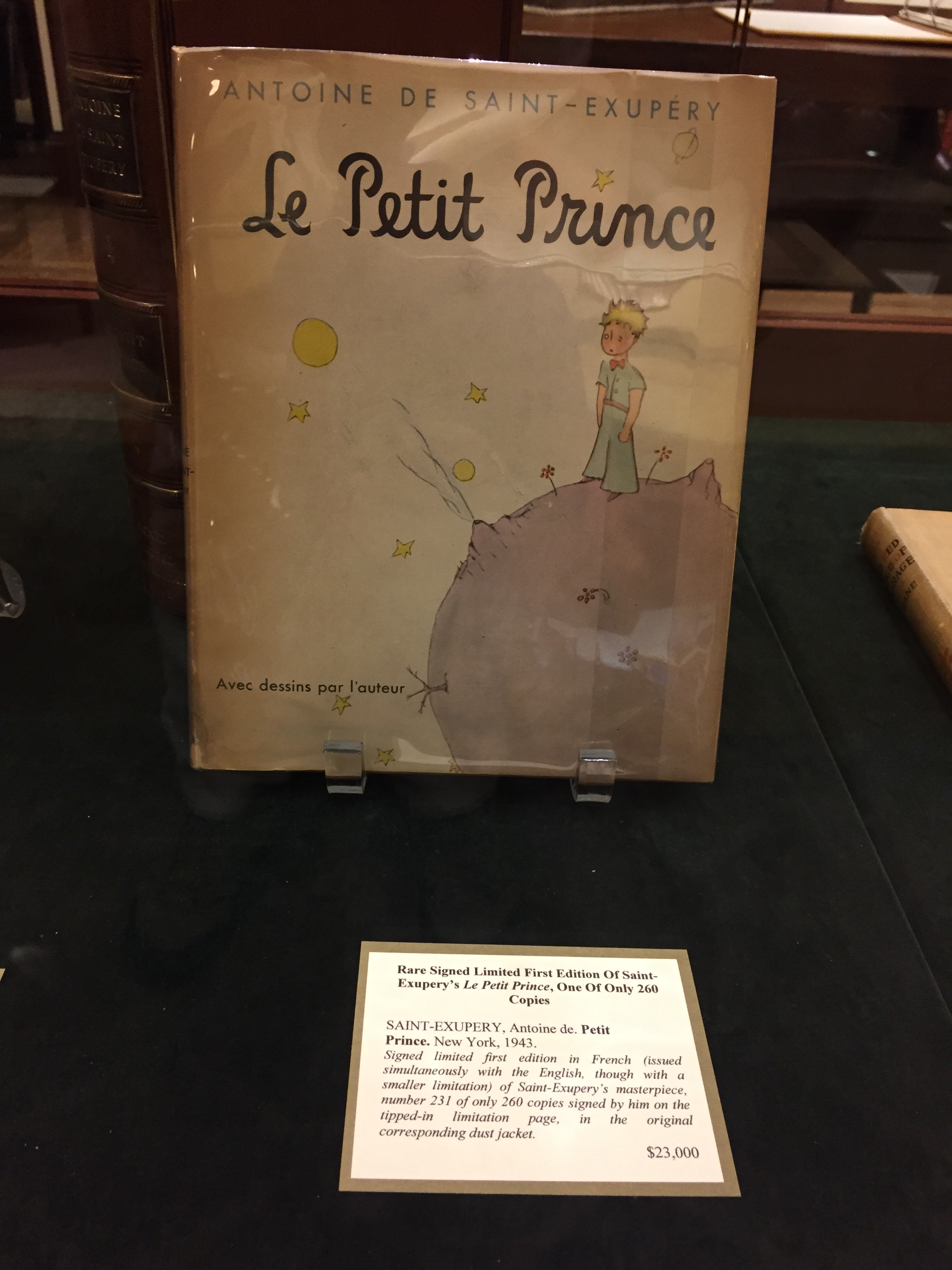
When I was in Las Vegas in October of 2015 for AWS re:Invent I took some time to go for a walk around the Venetian. I came upon Bauman Rare Books. In the store, I saw a copy of Saint Exupery's "Le Petit Price." It was a number 231 out of 260 copies signed by the author. It was selling for $23000.

When Amazon Kindle first came out in 2008 I was one of the early adopters. The device and the format proved perfect for me. The ability to impulse-purchase an electronic book anywhere I am and carry hundreds of books in one thin device allowed me to read dozens of books in the first year I got the Kindle. I can change the font size and read the books even when my eyes are tired. I don't get motion sick reading Kindle on the bus, something that routinely happens to me with printed books.

None of those books are special, in any way. They all look the same on my Kindle, just a row in the catalog. There is nothing that makes them "limited edition." None of them will ever be signed by an author. None of those electronic books will ever find themselves in a rare book store. The Kindle itself is unlikely to ever find itself on a collector's shelf.

To make the matters more precarious, when you buy an ebook you don't actually own it. In 2009, Amazon remotely wiped copies of Orwell's "1984" from the Kindle devices. There are articles and guides out there on how to protect your ebooks from the same fate, such as "DRM be damned: How to protect your Amazon e-books from being deleted" on the.

On the opposite side of the debate, there are opinions justifying Amazon's actions and their right to delete e-books from customer devices. When you pay for an ebook, you pay for a license to read it on your Kindle. This is analogous to how software is bought. When you pay for an app, you do not own it -- you purchase a license to use it and it can be revoked at any time, for any reason, with little warning. The same can, did, and will happen with e-books and electronically purchased music.

Despite all that, I have long since stopped buying printed books. The convenience outweighs the perception of impermanence. If the book is valuable or special, then I buy both -- the e-book for the convenience, and the printed version for the long term value. I can literally count with the fingers of one hand the number of printed versions of e-books that I purchased since getting a kindle.

If the power outages following the hurricane Sandy in the October of 2012 were a couple of days longer I would have had nothing to read. Imagine for a moment what would happen to the modern civilization in the event of a catastrophic solar flare that would at the very least suspend modern civilization, if not completely up-end it. If the power is out for months, and electronic device memories wiped clear, what will the humanity refer to for knowledge and guidance? What will happen to our family photographs, our music collections, and our Kindles?

People no longer collect music, they subscribe to it. We post thousands of photographs to Instagram and Flickr most of which get forgotten within hours from posting. We e-publish articles and blog posts, much like this one, that we know will be lost in the noise by tomorrow morning. We build apps that within weeks or days become outdated. There is hardly anything we put together today in the electronic form that is going to get discovered by our descendants a decade from now, never mind a century or a millennium.

The enterprises store years worth of data and process tens of thousands of transactions daily. For many industries, it is no longer possible to go back to using pencil, paper, and handwritten order forms. The financial industry is more reliant on electronics than ever. A major climate event or a World War affecting electronics is bound to disrupt the way we do business as we know it.

I do not know what the solution is. I do know that the humanity created a single point of failure for the entire civilization. Our long term strategical thinking has been reduced to near term instant gratification that will hardly last a generation.