Have computers become too complicated for teaching ?
[caption id="attachment_210" align="aligncenter" width="300"]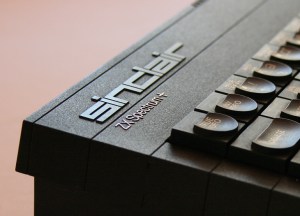 Sinclair ZX Spectrum+
Photo credit Julien[/caption]
I learned computer programming on a Cold War era Soviet programmable calculator called Elektronika MK-61. It was a very simple device that used a four element calculation stack, a handful of registers, and programming it was very much like writing assembler code. It had a number of undocumented features that made simple games possible. It's cousin MK-52 was used as an on board computer on a Soyuz spacecraft.
The point, however, is that it was a ridiculously simple device. There was no user interface to write home about. There were no objects, no persistence, no class hierarchies. To teach kids how to program was a matter of discussing sequences of mathematical calculations, writing them out to use postfix notation instead of infix, figuring out a way to only use a stack of four numbers deep, and then writing a program. If the kid is ready to solve a system of linear polynomial equations, she is ready to program a calculator to do the same.
My first computer was a Sinclair ZX Spectrum. It had a built in BASIC interpreter that also acted as a rudimentary operating system. To load a game you had to know at least one or two BASIC commands. Writing a simple platform game was remarkably easy to do.
This was in the 1980s Soviet Union. Fast forward to now. Before a student can even write a program they have to go through the process of learning how to use computers which over the years have become remarkably complex machines. Sure we have nice user interfaces but they are far from simple. They require a rudimentary understanding of how to use a mouse, a keyboard, how to download and start an application. The built in tools for programming are far too complex and far too specialized. Shell scripting on the Mac and Linux, batch files on Windows - neither is conducive to an environment where a kid can write their own version of PacMan or Tetris. Environments like Xcode and Eclipse require a college degree to even grasp what they do, while languages like Java are too advanced to teach at the middle school level.
So, how do we introduce programming to children ? Algorithmic thinking is an important skill for a 21st century world even if you don't end up becoming a software engineer. I have shown my 6 year old daughter how to program in MIT Scratch. To spice things up I put the Scratch itself on a USB stick and showed her how to load and save her programs. She seems to get it.
What is needed, however, is a very simple computer that boots into the BASIC interpreter much like the home computers of 1980s. Programmable calculators fulfill this goal to an extent and by all means should be introduced in schools at a very early stage. But nothing excites the imagination as a more tangible computer with tools that help a child produce a shareable executable program they can show off. Raspberry Pi is extremely intriguing and I am tempted to order one. But then - my kids are still too young to appreciate it and I am too busy, but I know a day is coming when I am going to show them how to get a small inexpensive computer do amazing things.
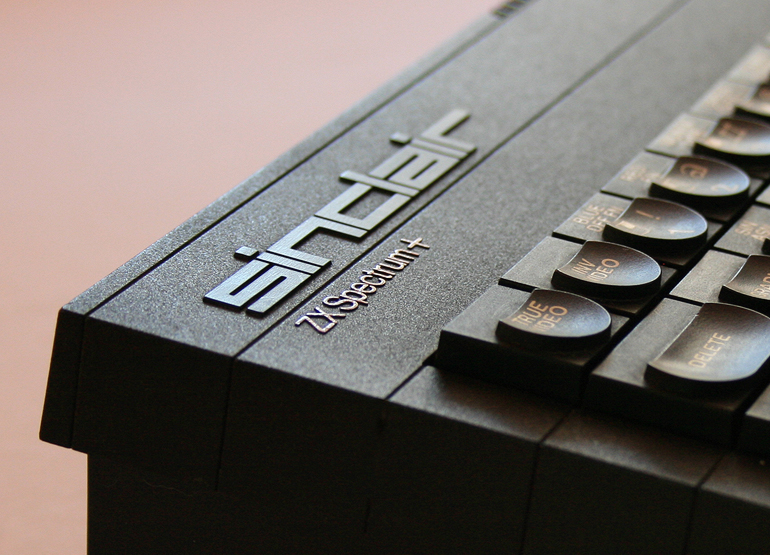 Sinclair ZX Spectrum+
Photo credit Julien[/caption]
I learned computer programming on a Cold War era Soviet programmable calculator called Elektronika MK-61. It was a very simple device that used a four element calculation stack, a handful of registers, and programming it was very much like writing assembler code. It had a number of undocumented features that made simple games possible. It's cousin MK-52 was used as an on board computer on a Soyuz spacecraft.
The point, however, is that it was a ridiculously simple device. There was no user interface to write home about. There were no objects, no persistence, no class hierarchies. To teach kids how to program was a matter of discussing sequences of mathematical calculations, writing them out to use postfix notation instead of infix, figuring out a way to only use a stack of four numbers deep, and then writing a program. If the kid is ready to solve a system of linear polynomial equations, she is ready to program a calculator to do the same.
My first computer was a Sinclair ZX Spectrum. It had a built in BASIC interpreter that also acted as a rudimentary operating system. To load a game you had to know at least one or two BASIC commands. Writing a simple platform game was remarkably easy to do.
This was in the 1980s Soviet Union. Fast forward to now. Before a student can even write a program they have to go through the process of learning how to use computers which over the years have become remarkably complex machines. Sure we have nice user interfaces but they are far from simple. They require a rudimentary understanding of how to use a mouse, a keyboard, how to download and start an application. The built in tools for programming are far too complex and far too specialized. Shell scripting on the Mac and Linux, batch files on Windows - neither is conducive to an environment where a kid can write their own version of PacMan or Tetris. Environments like Xcode and Eclipse require a college degree to even grasp what they do, while languages like Java are too advanced to teach at the middle school level.
So, how do we introduce programming to children ? Algorithmic thinking is an important skill for a 21st century world even if you don't end up becoming a software engineer. I have shown my 6 year old daughter how to program in MIT Scratch. To spice things up I put the Scratch itself on a USB stick and showed her how to load and save her programs. She seems to get it.
What is needed, however, is a very simple computer that boots into the BASIC interpreter much like the home computers of 1980s. Programmable calculators fulfill this goal to an extent and by all means should be introduced in schools at a very early stage. But nothing excites the imagination as a more tangible computer with tools that help a child produce a shareable executable program they can show off. Raspberry Pi is extremely intriguing and I am tempted to order one. But then - my kids are still too young to appreciate it and I am too busy, but I know a day is coming when I am going to show them how to get a small inexpensive computer do amazing things.